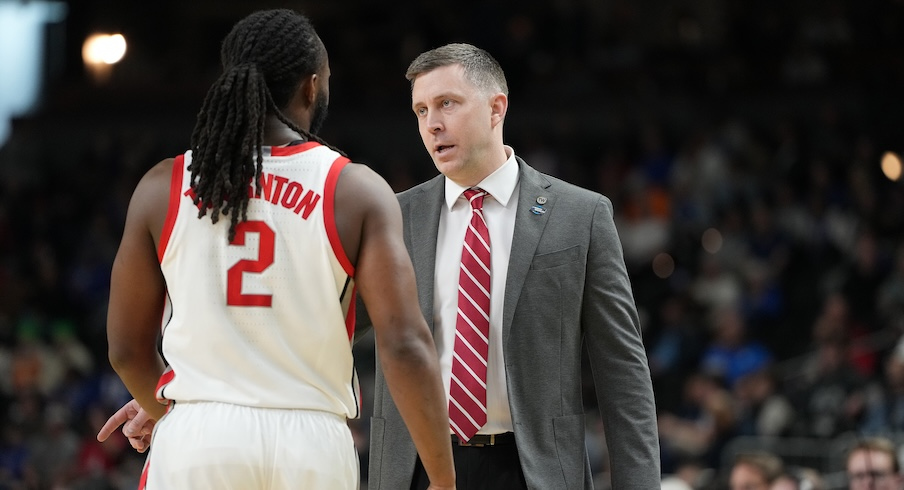
Jake Diebler’s first NCAA Tournament game as a head coach ended with a failed final play with a chance to tie or win the game.
After TCU’s Xavier Edmonds scored inside to give the Horned Frogs a 66-64 lead with 4.3 seconds left on the clock, Ohio State had time to draw up a play. The play Diebler and the Buckeyes drew up didn’t work, however, as Bruce Thornton was forced to heave a desperation shot from halfcourt, resulting in a two-point loss.
BUZZER SOUNDS. TCU GETS THE FIRST WIN OF #MarchMadness @TCUBasketball pic.twitter.com/q7zFXi6HNd
— NCAA March Madness (@MarchMadnessMBB) March 19, 2026
Instead of looking for a longer pass to start the possession, Thornton inbounded the ball to Christoph Tilly with Tilly quickly passing the ball back to Thornton. There were less than four seconds remaining on the clock by the time the ball got back in Thornton’s hands, and as two TCU defenders focused their attention on Thornton, the Ohio State point guard didn’t get a clear path to dribble down the court, forcing the Buckeyes’ all-time leading scorer to shoot the ball before he even reached the midcourt line.
In his postgame press conference, Diebler said the Buckeyes wanted the ball in their senior captain’s hands on the final possession. Diebler said Ohio State gave Thornton the freedom to decide whether to throw the ball down the court to Amare Bynum or Devin Royal or take a shot himself. Video of the play shows that Royal would have potentially been open for a shot had Thornton passed the ball instead, but it’s uncertain whether there would have been enough time for Royal to catch and shoot before the buzzer.
“We got the ball to Bruce on the run. We had two outlets down the floor for a throw ahead. I was watching him with the ball, so it was hard to see if those guys were open or not. I thought TCU corralled the ball well, and maybe that limited his ability to get the ball down the floor. But we were trying to get it to him on the run and give him freedom to make a decision,” Diebler said. “And had a couple outlets down the floor that if he felt like he could get it to them, we wanted to get it to them to either get a look or, if we could get it up there quick enough, use a timeout to set up in the halfcourt.”
According to the game broadcast and live stats provided to the media, Ohio State used its final timeout after TCU’s go-ahead basket. Diebler told reporters in the locker room after the game, however, that he had not called a timeout and that the clock was stopped by the officials, so he thought calling a timeout would be an option on the final play if Thornton reached midcourt faster.
“We felt like we had a chance to draw it, because they stopped to look at the clock, and in that moment I wanted to save my timeout in case we could get the ball down the floor and we didn’t have a look right away, we could set something up,” Diebler said. “We got the ball to Bruce on the run, would have liked a little more speed coming out of there, but I thought they did a good job corraling it. I didn't see if our outlets down the floor were open or not; I was kind of more focused on the ball. But we put the ball in (Thornton’s) hands in that moment and trusted him at a high level, and wish we could have manufactured a little better look certainly, but I don't know how well-covered that stuff was down the floor for the advance pass.”
Thornton told reporters in the locker room that he simply ran out of time to get a better look with how fast the Buckeyes needed to go the length of the court and the way TCU was defending him. Thornton felt the Buckeyes’ previous defensive possession and their poor performance in the first half, in which TCU outscored Ohio State 39-24, led to the loss more than the final play.
“We just didn't get the stop that we needed (on TCU’s last possession). It's hard with the time, with a full court shot and four seconds left,” Thornton said. “It wasn‘t the look I wanted, but they cupped the ball. They did a good job cupping the ball. It's just hard to get three dribbles on the other side of the court when somebody just guards you full court.”
Note: This story initially stated that Ohio State used its final timeout before the final play, but has been updated to reflect Diebler telling reporters after the game that he had not called a timeout. It is unclear whether or not the officials charged Ohio State a timeout, as CBS’ game broadcast as well as live stats provided to the media indicated that Ohio State had used its final timeout.